Grow New
Wall of love
Testimonials built in: asked for at the right moment, each one with proof of who wrote it.
What it is
Most testimonials on the internet look made up, because a lot of them are. A first name, a stock photo, five stars. I've never trusted them and I doubt your readers do either.
The wall of love works the other way around. You ask readers for a few words at a moment that makes sense, they write back through a link that already knows who they are, and each letter carries a receipt from your own records: what they bought, how long they've read you, and how many issues reached them. Nobody can edit their words afterwards, and that includes you.
01 Wall of love
Ask when they're happy
The best time to ask for a testimonial is right after something went well, and the worst is a cold email six months later. Kōlea lets you ask in the mail you were already sending.
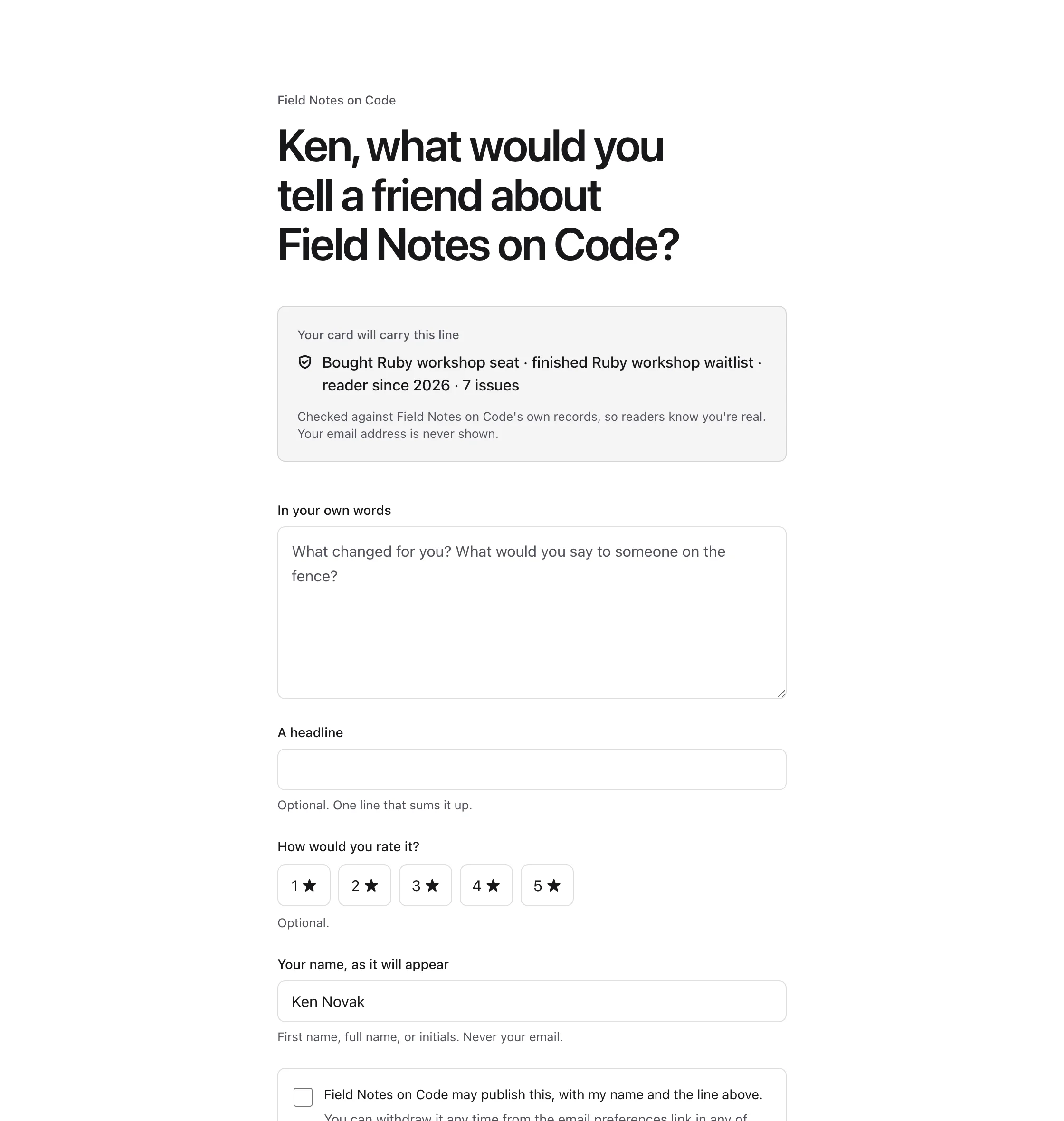
Put {{testimonial_link}} in a broadcast, a sequence step, or a form's reply, and every reader gets a link of their own. Launch Studio writes a follow-up a week after each purchase that asks how it's going, with the link at the bottom.
-
A link that already knows who's writing, so nobody types their name or email to leave you a few words. Fewer boxes means more people finish.
-
An ask that goes out a week after each sale, set up for you by Launch Studio, so you don't have to remember who bought what and when. You pick the day (anywhere from 1 to 60) and change the words.
-
A public link for everyone else, for the account or for one offer, so you can ask on a podcast or in a talk too. The writer confirms their email before the letter counts, so a stranger can't pretend to be a buyer.
-
The consent box is never ticked for them, so every letter on your wall is one the writer said you could publish. If they leave it unticked, only you read it.
02 Wall of love
Every letter has a receipt
When a reader writes in, Kōlea checks your own records and stamps a line on the letter. It's built once, the moment they send it, and it never changes after that.
-
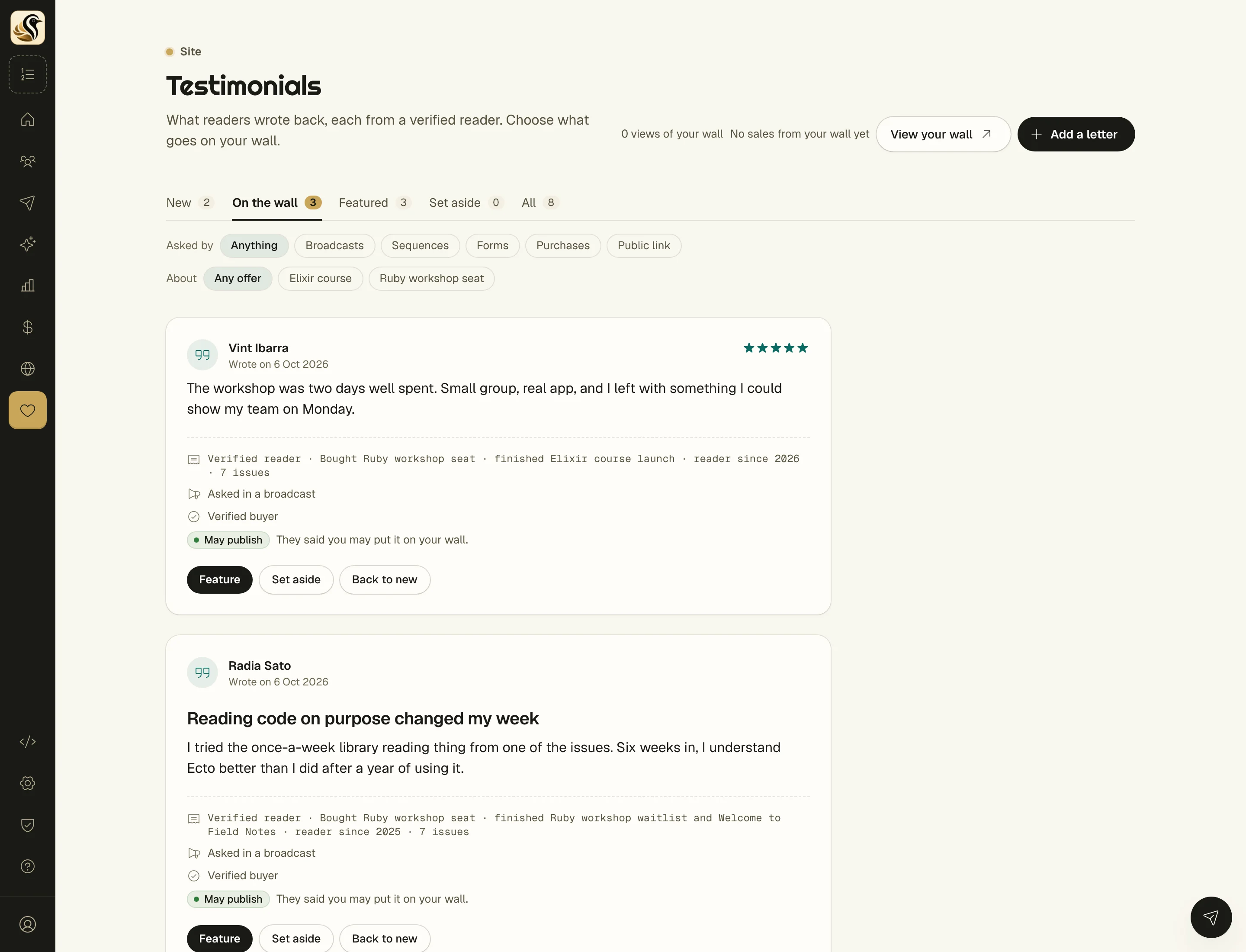
"Bought the Elixir course · reader since 2024 · 41 issues", taken from real sales and real deliveries, so a visitor can see the person actually read you and actually paid. Refunds and Stripe test-mode sales don't count.
-
An inbox with tabs for New, On the wall, Featured, and Set aside, so letters wait for you instead of going straight onto your site. You put up the ones you like and set the rest aside.
-
A note on where each one came from, a broadcast, a sequence, a form, a purchase, or your public link, so you can see which asks are working.
-
Room for the nice things people say elsewhere, a reply, a post on Bluesky, something said in person. You add it by hand, say why you're allowed to publish it, and it's labelled as hand-entered.
03 Wall of love
Show it anywhere
Your wall lives at /testimonials on your site, and it also works when you'd rather keep your site somewhere else. There's a script tag for any page, a block for emails and posts, and every offer's checkout page shows letters from people who bought it.
-
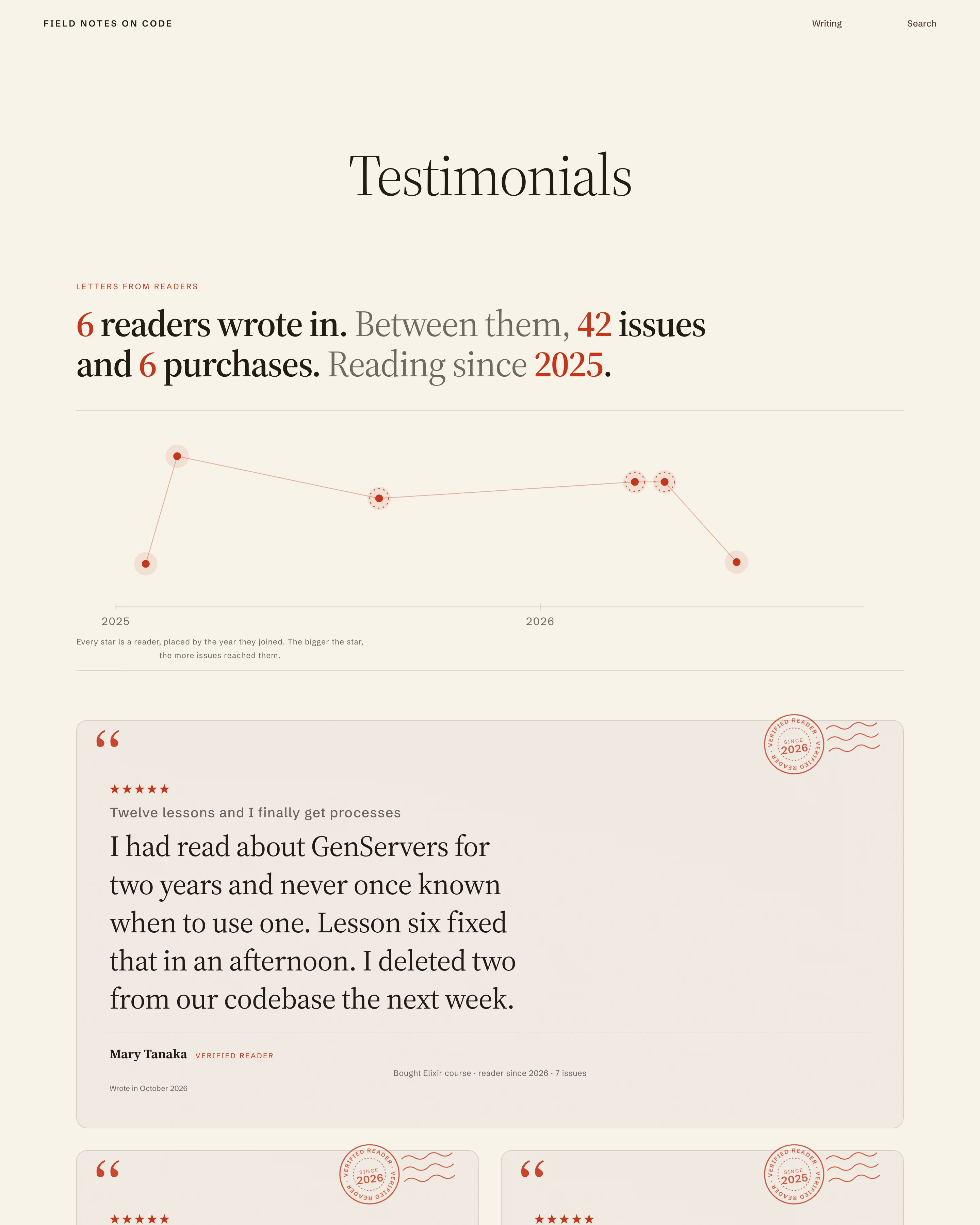
A sky of stars across the top of the wall, one per reader, placed by the year they joined and sized by how many issues reached them. It tells a visitor how long these people have been around before they read a word.
-
One script tag for WordPress, Webflow, Squarespace, or plain HTML, so the letters can sit on a sales page you already have. It draws fresh letters on every visit.
-
A Testimonials block in the editor, for a broadcast or a post. It stores a rule (featured, newest, buyers of an offer), and the letters are picked when the mail goes out.
-
A letter that's withdrawn stops showing everywhere, on the wall, in the embed, and in any email that hasn't gone out yet. Readers withdraw from their preferences page whenever they like.
04 Wall of love
Find out if it sells
This is the part I'm proudest of. Everyone says testimonials help sales, and I'd never seen anyone prove it for their own list.
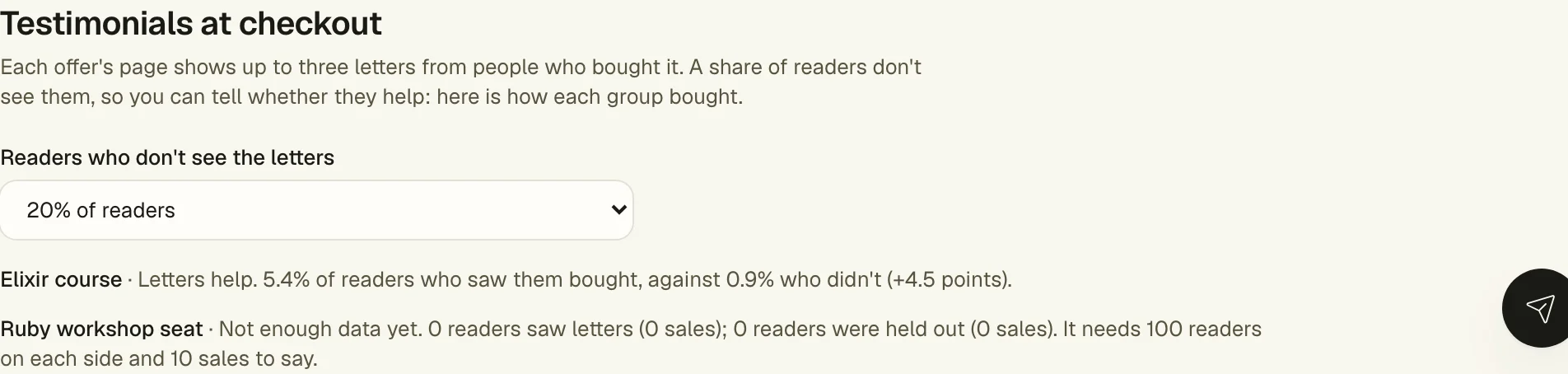
So Kōlea hides the letters from a share of visitors on your checkout pages (10% unless you change it) and counts who buys on each side. Once there's enough to go on, it tells you in plain words whether the letters help.
-
A holdout you can set to nobody, 5, 10, 20, or 50%, so you choose how much you're willing to test. Each visitor stays on the same side every time, with no cookie.
-
A verdict only when there's enough data, which means 100 visitors on each side and 10 sales between them. Before that it says "Not enough data yet" and shows you the counts.
-
"Letters help. 5.4% of readers who saw them bought, against 0.9% who didn't." That's an actual statistical test (95%, two proportions), so you're not reading tea leaves. If it can't tell, it says it's too close to call.
The short version
- Ask a week after a sale: Launch Studio's follow-up note carries the link, and any after-sale sequence can too.
- Put {{testimonial_link}} in any broadcast or sequence mail. Each reader gets their own link, with nothing to fill in but their words.
- Share a public link, for the whole account or one offer. A letter counts once the writer confirms their email.
- Every letter carries a receipt: what they bought, how long they've read you, how many issues reached them.
- Show the wall on your site, on any other site with one script tag, in an email or a post, and on an offer's sales page.
- Nothing goes up unless the writer says it's OK, and they can take it back from their preferences page.
- Kōlea holds a share of visitors back from seeing the letters and tells you whether they actually help sales.
Try it on your own list
Free for your first 500 subscribers, no credit card needed. We'll help you move your list over.